Even though the fact that she could push a one syllable word throughout a rollercoaster of her three plus octave range by dragging it out as though it were five syllables both endeared and infuriated the fans of Sarah Vaughan, she nonetheless ranked number one for five consecutive years as the “favorite girl singer” of her era.
Fluent in jazz, pop and bebop, Vaughan never encountered a standard song she wanted to sing straight, which was why her interpretation of “Body and Soul” sung on a dare in a contest as a teenager soon found her joining big bands where – much like Billie Holiday – she used her voice as an instrument to spontaneously get into the freewheeling rhythm as though it were a trumpet or saxophone.
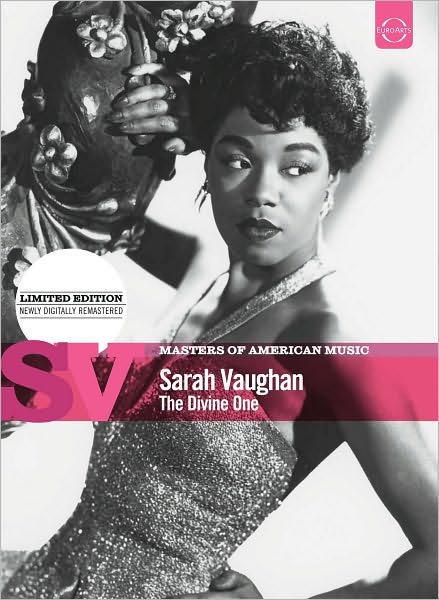
Known as The Divine One to the fans who likened Vaughan to operatic diva royalty, dubbed Sailor by those who new “Sassy” Sarah best for her gift to “out-cuss Popeye the Sailor Man” with the boys on the road, the diverse Ms. Vaughn is profiled in this compelling and beautifully preserved piece of musical portraiture.
Part documentary, part interview retrospective, and part musical performance, the Masters of American Music Limited Edition digitally remastered, region free, Sarah Vaughan: The Divine One is a delight for fans eager to discover more than just the bare minimum of biographical facts.
And this intimacy is what we're treated to from those who knew her best including the two she lived with in the form of her mother and her daughter – both of whom speak candidly about the private, professional Vaughan who had a big heart that was often broken but who managed to touch the hearts of so many all with that signature voice.
Although it clocks in at merely fifty-six minutes, the DVD which plays worldwide in all models of players as a Region 0 disc offers some lush performance footage that showcases Vaughan at various periods in her extraordinary career, highlighting the admirable way that unlike many jazz artists she was able to transcend musical genres and continue to have a career for five decades.
From “I've Got a Crush on You” to some of her most famous interpretations of “Misty,” “Somewhere Over the Rainbow” and “Send in the Clowns,” it's a beautiful work all around, even if it ultimately leaves you wanting more... much like a talented “girl singer” who stretches out the notes before exiting the stage to thunderous applause and cries of “Encore.”
One of four new discs released in the Masters of American Music series including titles devoted to John Coltrane, Count Basie and the blues with Bluesland, Sarah Vaughan: The Divine One follows the successful launch of the previous quartet of jazz themed limited edition bows in late 2009.
Although I believe that even admitting I'd never seen an episode of SYTYCD (as the kids call it) in its entirety cost me a handful of Twitter followers, I could think of no greater way to kick off the introduction to this review than by quoting from the one, the only Mr. Stephen Colbert.
On Wednesday, July 29 via Twitter himself, Colbert tweeted, "I suggest we do what every good American does when dissatisfied with the state of affairs. Watch an episode of 'So You Think You Can Dance'!"
And he's definitely right in his idea that when things get you down, as Gene Kelly once advised, there's nothing greater than to spend time, "Singin' in the Rain," or dancing like there's no tomorrow. Therefore it was a wonderful bit of pop-culture coincidence to find the arrival of that tweet hitting my computer screen just hours after I'd experienced the energy of the talented group of extraordinary cast-mates from the smash hit series via their blockbuster fitness DVDs.
I always recommend watching a fitness DVD in its entirety before you even begin to attempt any move in the program and of course as the rushed fine print of the medical warning (that looks an awful lot like the FBI one) promises it's advisable to consult your MD beforehand.
Ironically my screening of the discs last night was especially humorous considering it occurred directly after returning from Urgent Care wherein the MD on call informed me that too much exercise had left me with either a severely strained or torn calf muscle. However, unlike the ridiculously flexible cast of SYTYCD, I'm afraid my injury hadn't arisen from shaking my groove thing or getting my funk on but rather from swimming to my heart's content as one of the only ways to escape the heat in the Arizona desert in the summer (aside from jacking up your energy bill).
Feeling that even as a spectator, I wasn't quite ready for the Cardio Funk-- despite a background growing up with suburban parents who dutifully signed me up for tumbling and ballet at three and then tap, ballet, and jazz for years-- I opted to start up with the much less intense sounding Tone and Groove before moving onto the Funk.
Both DVDs begin similarly and with far more intellectuality than I approached my rush towards the water by dreaming of a childhood watching The Little Mermaid. No they didn't just jump in and instead these professions accurately and thoroughly describe just how important it is for those who intend to exercise to warm-up properly to prevent injury or waking up with severely sore muscles the next day. Sure, now you tell me!
Featuring six dancers from the past seasons of the wildly successful series that's going into its fifth season-- the performers alternate during the warm-up and cool down process by explaining directions to the viewer and it's quickly apparent to see which ones may possibly have had a background in either dance or exercise instruction. To explain--unfortunately despite how valuable it is-- this segment is uneven in both clarity and sound depending on whose turn it is to speak.
Thus, the warm-up on Tone and Groove loses points for clarity since only a few dancers truly address the way you should hold your frame including spinal positioning, neck alignment etc. with concern and enunciation such as Travis who aces this in both discs along with Twitch who encourages those who feel the need to go ahead and rewind the segment to warm-up again if they're not quite there yet.
The warm-up on Tone and Groove is much easier to get a handle on, although for a typical fitness enthusiast, the SYTYCD crew certainly wasn't kidding on the other disc when it came to addressing "cardio" since the warm-up alone feels like a typical aerobics level two workout at a health club. However, even the warm-up may take a few rewinds to finally begin to understand as Twitch had advised on the other disc due to the complexity and dance-like movements involved. Still, the one major benefit of Cardio Funk all-around was that largely it was the clear, encouraging, professional Courtney who led you through the start of it and the other dancers seem to pick up on the way she's able to walk people through instructions with success.
Moreover, the camera gets her cues, showing side views as dancers turn to show the right way to get a proper stretch although a constancy of the camera in remaining in full view of dancers including feet throughout the program would've been far more beneficial for those of us at home struggling to keep up.
In both widescreen releases from Paramount Home Entertainment that fill enhanced televisions (despite not making much use out of it with an extremely dull curtain and backdrop that looks like it would have cost less than the hair products used on one dancer), you're then taken through three diverse dance routines step-by-step.
In this way, it's reminiscent of Fame or those musical theatre cattle call dance auditions except slowed down to a snail's pace. That is until, of course the dancers quickly forget that we haven't studied at the Fame school, Julliard (and for many of us it's been a long time since childhood or community theatre) as I found myself baffled within an instant of Tone and Groove's first routine designed by the charismatic Twitch.
When he opens with a drop to the side and walk around, throwing his body off center without explaining how to hold your frame-- immediately I began realizing just how many people would inadvertently hurt themselves (back injuries mostly) no matter how many warm-ups they did unless of course, they had some recent dance, cheerleading, gymnastics, aerobics, yoga, or other physical training.
Although it's a great routine and not all of the dances are like that one as on Tone and Groove, I'd say that Katee's jazz number in focusing on your legs and arms is far more accessible with enough practice for those who are less experienced. Moreover, surprisingly, aside from thinking you should work with the warm-up of the first disc, I'd recommend the beautiful ballet meets jazz contemporary routine by Travis and calorie burning disco number off Cardio Funk by Courtney for beginners-- thereby working with both discs together to build up enough stamina to eventually move onto the rest.
One benefit of the choreography of the six dances contained on both discs which consist of various styles including hip-hop, Latin or contemporary is that they have been created in mind especially to challenge the areas you need most to stay in shape including your abs, thighs, stomach, arms, and booty.
Again, for those of you who can honestly answer the titular question of "So You Think You Can Dance" with a resounding yes, you can feel free to plunge right in, but for those of us who have not taken tap, ballet, jazz or contemporary dance or engaged in actors' body training in a good long while may want to balance between the two worthwhile discs-- both of which contain very solid cool downs and bonus interviews with fan favorite dancers.
Perhaps another answer could be as simple as watching them a few times to study before moving a muscle and then slowly start "doing your own thing" as the dancers encourage after a good warm-up to help get your muscles ready to groove, funk and tone with the rest. Likewise, an additional idea I had aside from initially just feeling overwhelmed by the "performance level" of the group-- even when they were only on say, stage two and still counting before music was introduced-- would be to encourage the discs as a purchase for parents of teens and students heading off to college as in this economy, it's hard to justify a gym membership.
FTC Disclosure: Per standard critical practice, I received these titles from the studio in order to evaluate for review. Receipt of the items had no impact on whether or not they received a favorable or unfavorable response.
Before Ken Burns debuted his epic PBS documentary smash Jazz in 2001, the award-winning multiple volume installments of the genre had struck a chord with audiences in the Masters of American Music series in the '80s and '90s, filtering into living rooms via VHS or televised broadcast.
For the first time since their debut more than a decade ago, this award-winning and highly acclaimed series has been released to jazz aficionados the world over, as Masters of American Music's first four volumes premiere on Limited Edition, slim-packaged all-region (aka Region 0 or Region free) DVDs ensuring that they'll play in all parts of the world.
While 2010 will bring more volumes to fans with the second installment's release of titles that focus on John Coltrane, Sarah Vaughan, Count Basie, and a special history of the blues dubbed Bluesland, the initial quartet of digitally remastered discs are dazzling.
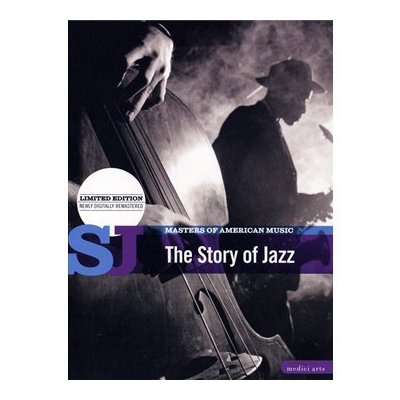
Assuming that it would be the first volume in the collection, I opted to play The Story of Jazz first before I discovered that it was actually the fourth installment. As I soon learned, Masters of American Music originally kicks off with exclusive specials focused solely on three of the most influential Masters themselves including the impressive "first and only authorized documentary" of Charlie Parker entitled Celebrating Bird which earned recognition and accolades from organizations including the American Film Institute in 1987.
Following up this portrait of Bird in an era that also found popular culture embracing Parker in Clint Eastwood's biopic of the same name, were the two other Masters selections, namely the Cable ACE award-winning documentary Lady Day: The Many Faces of Billie Holiday (Volume 2) and Volume 3's more intimate study of Thelonious Monk: American Composer.
The latter title sought out to present "the first fully rounded portrait of Monk" as opposed to the traditional way he was "often portrayed as not simply eccentric but crazy" by focusing on the bebop pianist's strength as a "witty satirist" who became "jazz's first major composer after Duke Ellington."
Yet, since I've dissected documentaries on the other figures before and wanted to focus on the heart of the series, I went right to The Story of Jazz first, which-- just like the others-- is fascinating not only for its historic footage of rare performances and inclusion of figures usually overlooked but also due to the straightforward and approachable narrative.
Since jazz can be such a daunting genre, as noticed in Burns' exhaustive but incredibly well-researched presentation, I appreciated the choice not to dwell on every single facet of each movement from its roots in West Africa to its official New Orleans birthplace and various incarnations including big band, swing, bebop, bop, free, and fusion.
No, the documentarians instead avoided minutia by opting to engage us by simultaneously inspiring our own interaction to look up more figures they discuss briefly and/or to look forward to the future in-depth releases on those we're particularly fascinated by including singer Sarah Vaughan who will receive her own volume in 2010.
Recipient of the 1995 Swing Journal award for the Best Music Program of the Year, The Story of Jazz-- similar to the rest-- was derived from a wide array of in-depth footage including more than 80 interviews with insiders and experts who understand the music, the players, and its impact on our history very well.
Additionally, correcting the main belief that it's simply an American art form and overall as purely American as "baseball," "national parks," or "apple pie" (two of which have also been the subject of Burns documentaries), the fact that the Masters of American Music series can be played on DVD in all regional country coded players is extremely fitting as the thesis of this set takes the "American Music" to an international level.
To this end, jazz is evaluated-- especially in The Story of Jazz, perhaps more than some of the biographical portrait discs-- as one of the globe's "greatest art form[s] of the twentieth century."
With its West African roots and the acknowledgment that Latin rhythms found their way into the music along with more international flavors as it gained in popularity in Europe and abroad, the all-encompassing genre of "jazz" eventually morphed into the epitome of one of its signature improvisational jams that can go on endlessly.
Still, the title impressed me even more for ensuring that figures like Bix Beiderbecke, James P. Johnson, Scott Joplin, and Buddy Bolden all received their due alongside the more popular and familiar names of Duke Ellington, Fletcher Henderson and others. Similarly, I couldn't help realizing that even those who may argue that they're averse to jazz and find their appreciation for the arts is firmly planted in other genres or realms like film, painting, or comedy, will definitely want to explore this work regardless.
For, although it's definitely suited and designed specifically for jazz fiends, the one underlying theme that pervades is that before someone like Thelonious Monk, Louis Armstrong or Duke Ellington can become a legend, they must have a strong foundation of knowledge in their subject.
In other words, if you don't understand chord progression, you certainly can't bebop or bop and swing definitely won't mean a thing if you don't know your scales and it's the reminder of just how much knowledge and dedication to their craft (whether formally or self-taught) was required in the development of the art form. This is especially evident when musicians ventured from standard technical requirements to free or fusion jazz that again makes it seem perfectly natural that many actors and comedians liken clicking in a scene or working together to playing music or creating "great jazz."
Whether you use the word "flow" as a writer when discussing the way that words will pour out of you or remain stranded when you're blocked or acknowledging that you can't attempt impressionistic or expressionistic painting without mastering still-life beforehand, the end result is always "jazz."
Thus, the music is the very essence of joyous, unrestrained, creative expression that's necessary to challenge yourself to study. While I recommend listening to more varieties to find what you like, I feel strongly that a basic documentary will do the trick. And sure enough-- and possibly without even realizing it the first time around-- The Story of Jazz will hip you to the fact that what you assumed was "just noise," has suddenly echoed off the screen and as Charles Mingus phrased it, get you "Hit in Your Soul" by the sound of creativity.
It seems as though every year dozens of films that celebrate the American spirit are released-- usually in the form of underdog sports movies-- wherein the outsider, the poorer kids, the unlikely team or the least experienced player defeats the favored competitor in spectacular glory. And while these usually result in some truly mesmerizing movies such as Rudy, The Greatest Game Ever Played, Miracle, Glory Road and Remember the Titans-- just like in high school where the jocks ruled the halls and sports funding is always renewed at the expense of the arts-- the one thing that's never fully celebrated is just how much the arts and especially music can be a similarly fascinating field. For whether you're on the stage or in the choir, if you take it seriously-- just like throwing or catching a ball-- working hard can in fact pay off... even if it's only temporary.
When musical biopics hit the silver screen-- it's always the drugs, the scandals, the groupie lifestyle and the drama that takes center stage more than anything else. And although the tales of musicians and especially jazz and blues artists in particular often end in tragedy-- the underdog spirit of fighting to be counted remains as yet another reminder of our true "only in America" dream to go out and get things done.
The life of Billie Holiday is no exception. Of course it ended in the most tragic of ways which we witnessed on the big screen in Lady Sings The Blues which reveled in the drugs and downward spiral instead of her accomplishments but honestly when you're presented with the facts that comprised the course of her life from birth onward, it seems as though that would be the inevitable conclusion.
Yet at the same time, that doesn't necessarily take away from just how extraordinary her accomplishments were. For she was able to bounce back from the most unspeakable of horrors again and again and-- after viewing this heartbreaking yet inspiring thirty minute biographical portrait of the woman-- I think it's safe to say that most of the athletes in the aforementioned biographical portraits had it extremely easy by comparison.
The granddaughter of a slave-- Billie Holiday was born to a nineteen year old mother and a jazz musician father who walked out on his responsibilities from the start as the first man to betray Holiday (yet certainly not the last). After the young Holiday was raped as a child-- as a female the crime was blamed on her and she was sentenced to a Catholic reform school until two years later when someone was finally able to free Billie.
Afterward, with no money and no way to support herself as a black young woman with nothing to her name in the racially unkind jazz era, she worked as a prostitute to get by until eventually she moved into the music world. And soon enough she joined groups as "the girl" or the singer, making appearances on the albums of legends like Goodman before she starred in a short jazz movie chronicling jealousy and heartbreak-- the building blocks of the blues-- with Duke Ellington.
Ironically ending up as part of the Fletcher Henderson orchestra in 1936 which had at one point been the one in which her father had been employed at the time of the pregnancy and birth of Holiday-- following her work with Henderson she forged an important alliance with Lester Young (who would bestow the nickname of "Lady Day" on Billie Holiday because of her elegance) and Count Basie.
The epitome of the sad fact that sometimes during moments of great professional success, you're struggling with personal heartbreak and drama-- shortly thereafter Holiday suffered through some bad marriages including one to a man who introduced her to heroin and opium and then reinforced her reliance on it. Facing the double standard of being a black woman in the business and having to dress as a maid to costar with Louis Armstrong in a bit part in a Hollywood movie--after Billie's mother died, she soon after lost her cabaret performers license and ended up in jail for a drug charge which garnered her eight months behind bars while some of the male musicians roamed free, using and abusing with wilder abandon.
Although her voice began to decline from drugs and personal stress and Holiday's next chapter of her life would be her most bitter one which came out in an autobiography-- perhaps the strongest way she wove her disappointment into art was with the recording of the song the DVD notes she "used as a weapon" with the release of "Strange Fruit" which had been written expressly for her and became a staple of her set list despite its unpopularity as an anti-racism song that confronted the race issue head on.
While of course, her decline would continue until a tragic and far too young death which found her with police guard and under arrest while literally on her death bed (as though she were a dangerous threat)-- throughout the fairly succinct biography that also boasts some vintage, rare and/or unreleased performance footage and the Ellington short-- I couldn't help but admire the way she never gave into the setbacks that kept stacking up like dominoes until they just kept pushing into one another for the final crash.
While of course she was born into the blues and stayed in the blues (by working in the field that had made her father the type of man who put family second and walked out on her as a baby), and ultimately she died in the blues-- the reason she sang the blues so well is because she lived them. But in doing so, she never let that stop her from trying to conquer the next obstacle in her path as a musical version of one of those Disney Titans we know we'll always Remember.
Along with legendary crooners like Frank Sinatra, Dean Martin, Nat King Cole, Sammy Davis Jr. and Bobby Darin, the great Johnny Mathis recorded some of his very best songs for Sony Music's Columbia Records.
In a bold move by Collectors' Choice Music to re-release the material from Sony-- they decided to "reissue virtually ALL of his ‘60s albums that have never been on CD before." And to this end they selected ten best-selling classic works that the company then divided in half to pair together in five unique 2-CD sets.
Having hit stores and online retailers this week on June 9, Collectors' Choice debuted this all-new collection to fans, augmenting the stellar Columbia records from Johnny Mathis with "detailed liner notes" penned by James Ritz as well the original cover art of the records included in each booklet.
Album Information (Descriptions Provided By Collectors' Choice)
Johnny Mathis: I’ll Buy You a Star/Live It Up!
Of the ten albums we’re reissuing, I’ll Buy You a Star is the only one that’s come out on CD before, but we had to include it because it made such a perfect pairing with Live It Up! Why? Because both of them boast arrangements by the great Nelson Riddle!
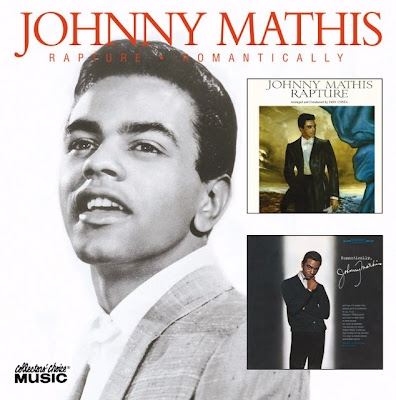
Johnny Mathis: Rapture/Romantically
Another perfect Mathis pairing, these 1962 and 1963 albums both featured arrangements by the legendary Don Costa, and both soared to the highest reaches of the charts.
Johnny Mathis: Up, Up and Away/Love Is Blue
These 1967 and 1968 albums marked Johnny’s triumphant return to the Columbia label from Mercury, where he spent the middle part of the decade. They also marked a shift in his repertoire away from the standards that had dominated his previous Columbia albums towards more contemporary material, whose familiar melodies take on a whole new sheen when burnished by Johnny’s ethereal tenor.
Johnny Mathis: Those Were the Days/Love Theme from “Romeo & Juliet”
Johnny Mathis doing a Doors tune? Yup—and doing it well, along with a host of other late-’60s pop favorites on these 1968 and 1969 albums. Robert Mersey, who arranged Johnny’s previous two Columbia albums, conducts on Those Were the Days, while the great Ernie Freeman takes up the baton on Love Theme.
Johnny Mathis: People/The Impossible Dream
Johnny’s warm, mellifluous interpretations on these two 1969 albums will make you hear these songs in a whole new way, even if you’ve heard them hundreds of times. A good example is his dramatically slowed-down reading of “Sunny”; the contemplative, even wistful tone of his performance really gives the “dark days” of the song’s lyrics equal weight to the bright ones, an insight usually lost in the song’s breezier interpretations.
Due to time constraints, I wasn't able to review the albums in great detail but Collectors' Choice Music was kind enough to send the passionate duo of Rapture/Romantically my way.
And having always had a reverence for the classic albums produced for all the greats at Sony's Columbia Records including Frank Sinatra whose Classic Sinatra II which consisted entirely of his vintage Columbia studio session I reviewed earlier in the week, I was thrilled to explore the Mathis works as well.
With both albums conducted and arranged by Don Costa to enormous success with record buyers in '62 and '63 respectively, they flow nicely into one another and feature everything from numerous Rodgers and Hammerstein tracks on Romantically to more intense works like the titular "Rapture" on the first album.
Of course while it's impossible to choose a favorite since if you're a fan you probably know the material very well, nonetheless here's a list of what I felt were the top five standouts on both records (in alphabetical order):
Rapture
"I Was Telling Her About You" "Lament (Love, I Found You Gone)" "Love Me As Though There Were No Tomorrow" "My Darling, My Darling" "Rapture"
Romantically
"All That is Missing" "Autumn in New York" "It's Only a Paper Moon" "Moonlight in Vermont" "The Sound of Music"
More About Johnny Mathis (From Collector's Choice Music)
"In early 1956 a young man was faced with a life-altering dilemma that could have had dire consequences had he not chosen the right course. Having been a star athlete in both high school and college, he was invited to attend the trials for the U. S. Olympic track-and-field team. But he was also blessed with a unique voice and vocal style that caught the eye of Columbia Records executives and was asked to come to New York to begin work on his first recording session.
"Prompted by his father, 21-year old John Royce Mathis chose the latter and passed on his opportunity to become a member of the Olympic team, opting instead for a chance to break into the uncertain world of popular music. A half-century later he has yet to look back.
"Over the course of those 50+ years, Johnny Mathis has sold several hundred million records and has become one of the most beloved voices in popular music. Over the span of his first three decades he charted nearly four dozen singles on the best seller charts, including such seminal romantic ballads as "Wonderful! Wonderful!," "It’s Not For Me To Say," "The Twelfth Of Never" and "Chances Are" (his first of two #1s).
But Mathis’ real staying power has been as an album seller; his Johnny’s Greatest Hits (the record industry’s FIRST greatest hits package) alone stayed on the charts for an incredible 9 ½ years and by most accounts next to Frank Sinatra, he’s been the most consistent album-seller of the modern era, having recorded upwards of 75 original collections."
Long before the advent of Google searches, Wikipedia, MySpace, Facebook, Twitter, or YouTube-- when someone wanted to learn more about a subject, they had to venture to enormous buildings like libraries and stores which housed big, heavy, dust collecting, paper filled items called books.
And, of course, the mother of all texts--reliability-wise-- was a reference book or an encyclopedia as surely, the authors would have to fact check and one would assume that unlike Wikipedia (which can be updated by anyone), everything would need to be verified... or so you would think.
In 1991 Oscar nominated and Sundance award-winning filmmaker and jazz musician Raymond De Felitta found himself in awe of an unfamiliar voice crooning on a local radio station playing Charles Mingus' Paris in Blue. Simply put,De Felitta was hooked.
Mesmerized by what he’d heard, De Felitta set about tracking down every recording he could of the jazz singer Jackie Paris that resulted in obscure discoveries such as Japanese imports of classic albums including one misfiled under the name of Oscar Peterson. In addition to the the musical side, he also yearned to uncover more about the musician with pitch-perfect phrasing.
The biographical trail of Jackie Paris moved from hot to cool in the 1960s as the British Invasion made jazz a figurative musical dinosaur. And following that all information regarding Paris's life journeyed from cool to frozen in the 1970s when decades later, De Felitta read in a well-respected jazz-centric biographical encyclopedia that stated that Jackie Paris had died in 1977, while only in his early 50s.
Upon this newly acquired information, the filmmaker was content with what De Felitta referred to as his collection of “the handful of CDs and vinyl that comprised the meager but glorious output of Paris's career,” which included his signature rendition of “Skylark”-- his most famous and swoony work. And moreover, essentially to De Felitta the story of Jackie Paris seemed to end there in the all-too familiar jazz ending of death with more of the man's soul being captured on vinyl than in the history books.
However, his fascination with the Italian-American, New Jersey native who grew up entertaining, tap dancing and singing with a veritable who’s who of jazz legends (including Charlie Parker with whom sadly he never recorded any material despite a six month tour) never waned. Likewise, De Felitta became the latest in a long line of fans.
And even later he ascertained that Paris’s allegiance of admirers also had included the loftiest of greats from the era: Peggy Lee, who had arranged an elaborate audition for Jackie Paris with a major label; Lenny Bruce who helped him perfect his stage presence and humor as his opening act in one of the documentary’s most fascinating discoveries as a letter penned by Bruce is read aloud; musician Billy Vera who dubbed Paris “Chet Baker times ten”; later referred to as “the kissy singer” by Sarah Vaughan; as well as being called the personal favorite singer of Ms. Ella Fitzgerald.
Yet while his envious musical resume and near jazz-version of the six degrees of Kevin Bacon which linked him in roughly three degrees or less with every major recording artist in his jazz heyday was epic, De Felitta received the greatest shock when thirteen years following the first time he’d heard Paris’s voice over the speakers of his car, he learned that the “dead” singer was anything but.
When De Felitta happened upon a brief New Yorker magazine notice featuring club dates for the local Jazz Standard in 2004 with the name of Jackie Paris as the main attraction, he was stunned. “Jackie Paris? The one who died in 1977? How is he singing? Via a Ouija board?” De Felitta wondered but taking the chance, he decided to go.
Once he landed inside The Standard, he realized that “Paris was alive -- not exactly well, but still handsome and charismatic. And he was in fine form, singing a set that included three of my favorites...”although, while Jackie Paris politely but crisply dismissed him --which led De Felitta to the realization that "not all was peaceful in Parisland,” when he ventured back again the following evening, Paris started to warm up. Much to his amazement, Jackie Paris spoke to him in earnest between sets wherein he confessed that “he was terminally ill” and that therefore, this was probably his final gig.
In response, De Felitta went into overdrive blending together both the roles of fan and filmmaker and wanting to record it as a legacy “to bring the world's attention [to] the singer whose work I'd found so compellingly beautiful.” To this end, “working with borrowed video equipment,” he spent seven weeks with Paris before the man passed away on June 14 of the same year.
However, what started as a “tribute film,” filled with reminisces, interviews, and other accounts from both Paris himself along with others with whom he’s played, lived and loved whose phone numbers and addresses the musician graciously offered the filmmaker soon became a bit more of a mystery as De Felitta changed the approach from an introduction to one that took a more analytical stance.
Dedicating more energy to his new thesis of why Jackie Paris had become as the film's tag-line described “the greatest singer you've never heard,” De Felitta went to unprecedented lengths to address just why the man was always on the brink of stardom but repeatedly fell into obscurity.
Although he never really arrives at a set conclusion, several possible reasons are given in this fascinating piece of musical documentary portraiture which serves up the usual suspects as well as a decidedly different side to the man we’re consistently faced with throughout. Admirably he takes Jackie at his word and never probed him directly even though he had evidence to the contrary about some issues with which the man was less than forthcoming.
Yet, meanwhile De Felitta introduces us to two very different women who were both at one point Mrs. Jackie Paris, along with relatives, a denied son, etc. as we’re faced with tales of ego, temper, deep-rooted family dysfunction (in the form of a devastating account of his brother and abusive father), along with questions of whether refusing mafia support of his career or slugging the wrong club owner who was most likely "connected" always kept him from the top.
Overall, this routinely makes for a mesmerizing film that evolves much like an improvised jazz riff throughout its changes in tempo where some are successful with only a few rough patches in editing as we remain a bit foggy about some of the facts like we’d had a sax blaring too close to our eardrum for a bit.
However, the one issue that remains a subtext that's only vaguely questioned by De Felitta in his voice over narration at the end when quoting Orson Welles is just how much we need to know about artists to dig their work. And, likewise, whether or not the “search” for Jackie Paris was really a mystery in the end if he was happily living under the radar, definitely bitter about wasted potential, missed opportunities, and lack of money but essentially okay in his New York life.
This is especially the case since—while I’m incredibly grateful for De Felitta’s passion, compassion, and integrity in introducing a wonderful overlooked talent to a new generation—ultimately, I feel nearly as confused as I was near the beginning and still have just as many questions about Paris as I had from the middle of the picture to when the final credits began to roll.
This being said, the intent and style shown by De Felitta is warm and inviting. And it's what carries us through the work, despite the mysterious head-scratching footage we’re sometimes shown with contradictory interviews and a few loose ends that seem like they were left abandoned on the floor of the cutting room such as the discussion of a “wife?” who died of cancer and then talk of a divorce enters in the same sentence and a few interviewees aren’t identified at all. Yet this is all easy to overlook as soon as Jackie Paris’s astounding voice fills the soundtrack and when you couple this with the exquisite care he took towards his subject, De Felitta’s ‘Tis Autumn is a great find for jazz fans and documentary lovers alike.
Nominated for the Grand Jury Prize at the Sundance Film Festival, De Felitta’s Search marks his strongest work since I first discovered his overlooked, Sundance Audience Award winning sleeper Two Family House which is not only a personal indie favorite—but much like this film—a highly personal work for the director and one in which his passion is so infectious that I selected it without hesitation for inclusion in a local film series I ran in our community.
And similarly--just like House had people nodding along to the music in their seats—‘Tis Autumn will definitely make you want to rush out and track down the music you can find by the musician… if, that is, there’s still any left in print here in the United States. So in other words, our “musical” Search for Jackie Paris continues.
Whether he was dubbed "the Father of the Tenor Saxophone," "the best tenor player in the world" or as this All-Region concert DVD from Standing Oh!vation notes "the true originator of the tenor saxophone as a solo instrument in jazz," Coleman Hawkins had an enviable professional run that lasted for roughly forty years.
Moving from piano to cello to the tenor saxophone before the age of ten years old back "when the saxophone was considered a novelty instrument, used in vaudeville and as a poor substitute for the trombone in marching bands," Hawkins' career flourished by the time he turned twelve, working for Mamie Smith's Jazz Hounds until he eventually found a home with the newly formed Fletcher Henderson Orchestra, playing alongside Louis Armstrong.
Conquering fans around the globe by moving to Europe in the '30s where he collaborated with Django Reinhardt and Stephane Grapelli-- when he returned back to the states, he still managed to outshine the up-and-comer Lester Young "by winning a few heated jam sessions," but he never neglected to share the spotlight-- celebrating artists from all backgrounds as a band leader as well as sharing the stage and the recording studio with such legends as Miles Davis, Thelonious Monk, John Coltrane, Duke Ellington, Dizzy Gillespie, and Sonny Rollins.
Recording the first ever "unaccompanied saxophone solo, 'Picasso,'" Hawkins managed to remain current by listening to all styles although intriguingly he noted that he preferred live jazz concerts and bought very few albums in his genre, instead favoring the passion of opera and classical compositions by Bach.
In this extraordinary DVD that offers viewers a chance to see Hawkins perform in London, Paris and Brussels in the early to mid sixties (just a few short years before his death), we're treated to some previously unreleased and remarkably rare footage over the course of its approximately one hundred and thirty-six minute running time.
Cherishing the intricacies of the music and the way that Hawkins gave unprecedented solo opportunities to his talented bandmates that change over the course of the included concerts-- the disc introduces each individual segment by announcing the date and location as well as the full line-up of musicians and name and composer of each track played.
Jumping around in chronology, we begin in London's Town Hall in 1964 that features some beautiful slower pieces including "September Song" that shows Hawkins' strength as a sax man until the swinging "Centerpiece" keeps us moving through the old jazz classic "Caravan."
Although some critics argue that Hawkins' best work ended in 1965, it's the 1966 concert at London's Royal Jazz Festival on the DVD that mostly caught my attention yet it was most likely due to the strength of its line-up including Benny Carter on alto-sax, Teddy Wilson on piano, Bob Cranshaw on bass, and the incomparable Louise Bellson on drums.
With Cranshaw's bass inviting us to snap along to "Blue Lou," before Wilson sets up Hawkins to shine in the bittersweet rendition of the Vernon Duke and Ira Gershwin number "I Can't Get Started," and Hawk's trademark "Body and Soul"-- intriguingly the knockout tune in this particular concert and indeed the entire DVD is in the "Disorder at the Border" final number which contains not only the best drumming I've ever seen in my life but makes the disc all the more extraordinary for finally offering this unreleased footage that once and for all shows the utmost importance of percussionists.
There seems to be an old joke among musicians that if you can't play an instrument, just become a drummer but the Italian virtuoso Louie Bellson (a shortened version of his overwhelmingly long Italian name that would fill an entire address label) embarrasses all the drummer prejudices with an incredible performance in the nearly fifteen minute number as he offers extended solos that do for the drums what Hendrix did for the guitar with "Star Spangled Banner." A remarkable feat of music-making and a tribute to the man who sadly passed away on Valentine's Day this year-- Bellson, much like Hawkins is truly one of a kind and will definitely be missed.
The DVD also contains more footage from other concerts in Paris (consisting of one brief rendition of "Moonglow" that sounds like we're just jumping into it shortly after it starts like walking into a film while the credits are rolling) and Belgium including an inferior version of "Disorder at the Border" minus Bellson that nonetheless is a peppy but alternate take featuring more piano (by Geroge Arvanitas) as well as additional tracks from the Coleman Hawkins-Roy Eldridge Sextet taken from the 1961 New York short film After Hours.
And while it's filled with some standout pieces, once Bellson rips into "Disorder" during the tenth track, it's all downhill from there. Still, a great find that's a rare treat for Hawkins fans and one that-- when I say "downhill" just means in comparison to "Disorder" but still remains far better than what sadly passes for jazz in the Kenny G era of today.
Coleman Hawkins In Europe is not only worth hunting down for jazz aficionados and those who worship the sax but one that should be shown to every drummer working today. Highly recommended and thankfully compatible with each and every region code DVD player Coleman Hawkins In Europe marks another fine entry into the historically important and downright entertaining Standing Oh!vation collection.
Legend has it that William Basie earned the handle of "Count" from an impressed radio announcer or emcee after realizing "there was already a King (of swing, Benny Goodman), a Duke (Ellington) and an Earl (Hines)."
And while the title of Count mostly brings up images of the number happy Sesame Street character who lived and breathed arithmetic to those in my generation-- Mr. Basie applied the same type of left brain logic with a splendid amount of right brain creativity-- in developing one of the most extraordinary American bands of the twentieth century.
Still going strong today after more than twenty years following Basie's death and led by bass trombonist Bill Hughes who appears in both concert venues featured on the DVD-- musician Count Basie and his incredible orchestra provided that rare "happy ending" case in the history of jazz as it managed to move with the times by embracing and conquering every form from Dixie to Swing to Big Band.
Moreover, Basie helped launch the careers of so many masters-- surrounding himself only with the best but always selflessly promoting the many talented soloists and musical arrangers throughout his extraordinary career (including Lester Young, Eddie "Lockjaw" Davis, Quincy Jones, Neal Hefti, Sam Nestico, Richard Boone, Bobby Plater, Eric Dixon, Marshall Royal, Freddie Green, Marlena Shaw, and many, many more.
While 1968 found America in a state of political and social turmoil during the Vietnam War era, leaders and public figures assassinated, the Black Panther party gaining momentum, and women starting to fight for their own sexual revolution-- it's hard to imagine Basie's jazz music as a companion to the year that seems to come complete with its own trippy rock soundtrack. Yet, Basie still remained popular-- essentially leading his orchestra for roughly fifty years during his lifetime.
With a sound that "was characterized by a light swinging rhythm section that he led from the piano" and focused on "generous soloing" and "lively ensemble work," so that it was a complete team effort-- while he'll always be known as the man with the delicate touch on the keyboard, perhaps the best assessment of his magic was in the argument one writer proclaimed that "his instrument was his band."
And in 1968, he was still going strong despite the turmoil back home as the child who grew up dreaming "of a traveling life, inspired by the carnivals which came to town," and his frequent escape to the silent movies (where one day--playing by ear-- he filled in for the absent pianist and discovered the art of improvisation), fulfilled his desire for adventure by taking Europe by storm. And directly in the eye of the Basie tornado of swing in Europe, in this newly released Impro-Jazz all region compatible roughly seventy minute DVD, viewers can sit spellbound as it charts vintage performances he gave in Berlin, Germany and Stockholm, Sweden.
A terrific find for jazz lovers-- surprisingly, although the footage seems a bit grainy with a distant hiss sound when the DVD begins, soon Basie launches us fully into the sounds of his enormous orchestra in two concerts that could also serve as a wonderful piece of background music for an intimate dinner party or '60s themed evening in.
The concert footage features rows and rows of musicians and in the selection of tracks managing to move forwards and backwards in time to play his first big hit "One O'Clock Jump," (in the closing of the Berlin concert) along with some tracks that feel far more contemporary such as Eric Dixon's incredible "Blues For Ilean" which sounds as though it wouldn't have been out of place in a Henry Mancini score or as a new theme song for TV's Get Smart.
"California Soul" singer Marlena Shaw--who was the first female artist ever signed to the famous Blue Note Jazz label-- appears for a few great renditions on the DVD. In her four year career singing with Count Basie's orchestra following her word-of-mouth breakthrough "wowing audiences in the Catskills, Playboy clubs and various other East Coast venues," and the phenomenally successful recording of her song "Mercy, Mercy, Mercy" which impressed the Count-- we get a great sense of her dynamic range on this riveting DVD.
For, just like Basie who made the orchestra his instrument, Shaw manages to move around the register in varying deliveries to become that rare singer who both seems like both a soloist and an integral one-of-a-kind instrument in her own right. While it's often easy for a singer to either overpower a band or find their own voice overpowered by a few instruments, let alone the massively intricate small town sized one run by Basie-- her standout track on this DVD is when she appears to perform"Bill Bailey" before she tops herself again in the achy and soulful "Muddy Water Blues."
Featuring some incredible saxophone solos and outstanding numbers like "Cherokee," the standard jazz classic "A Night in Tunisia," the beautifully wistful sounds of "Lonely Street" that make it seem as though it were ideal for a lovelorn Woody Allen movie, soon the thirteen track performance in Berlin moves us right into Stockholm. Once in Sweden and despite some mic difficulties at the start--the camera work appears to be much more creative, really focusing on the specific performers themselves.
Although a majority of the tracks in the very brief Stockholm section are repeats (although I'm sure nobody would complain at the chance of hearing an even better rendition of "All Of Me," and the awesome "Blues For Ilean" and "Cherokee" again), the first track is one of the best on the DVD as we hear Neal Hefti's "Splanky" which is so inviting, we even see members of the band unable to stop tapping their feet or bobbing their head as though they were audience members listening for the first time.
A solid, unselfish and highly entertaining group that seems to be the epitome of teamwork but still managing to give every incredible member a chance to shine in the spotlight-- while Basie fans may just be interested in picking it up simply for the Count himself-- seeing the entire orchestra in action makes you realize that in music, what you hear is only half the story.
Likewise, being given a chance to travel back in time to witness these vital performances makes one appreciate the songs and the man you thought you knew on a whole other level-- since there would be no orchestra without Count Basie and without the orchestra there would be no Count Basie.
DVD Track List
Berlin, Germany, November 9, 1968
1) All Of Me 2) Hittin' Twelve 3) Blues For Ilean 4) Bill Bailey 5) On A Clear Day 6) Cherokee 7) Good Time Blues 8) A Night In Tunisia 9) Muddy Water Blues 10) Whirly-Bird 11) Lonely Street 12) The Magic Flea 13) One O'Clock Jump
Stockholm, Sweden, November 12, 1968
14) Splanky 15) All Of Me 16) Hittin' Twelve 17) Blues For Ilean 18) Cherokee
Walking Movie Encyclopedia at Film Intuition; 3-Time National Award Winning Scribe; Film Reviewer; "Watch With Jen" Podcast Host; Screenwriter; Movie Discussion Host; BA in Film Studies & Communication.